|

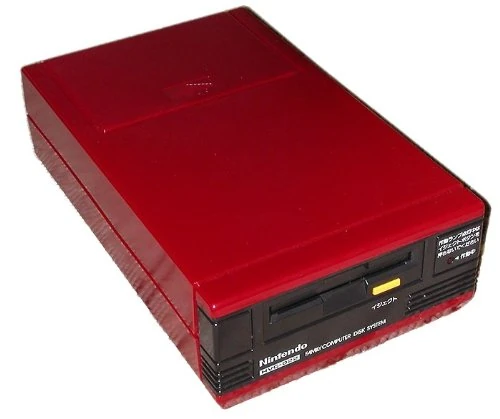
The Family Computer Disk System(JP) (FDS), also known as the Famicom Disk System(JP), is a peripheral for the Family Computer console. The Disk System used proprietary floppy disks called "Disk Cards" and additional sound channels.
A RAM adapter cartridge, included with the Disk System, contained the disk drive controller as well as extra RAM required for game operation. The Disk System itself included a FM synthesis chip that allowed for more realistic sound on Disk System games.
4.5 million units were sold in Japan, and though it was announced for the United States, Nintendo of America eventually decided against releasing it, though a port on the bottom of the NES exists that went unused, implying that it would have been used for a disk-based add-on similar to the Famicom Disk System. Diskun was the mascot for the hardware.
BIOS
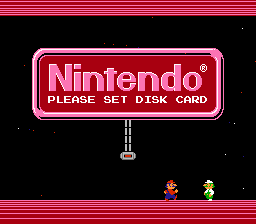
Famicom Disk System BIOS screen. Luigi had turned the lights off, then Mario turned the lights on and started chasing his brother.
Mario and Luigi appear in Famicom Disk System's BIOS. There, Luigi would "turn off" the light and Mario would turn it on again, with a different color each time, until a disk is inserted. Mario and Luigi's sprites were from Mario Bros.
Twin Famicom
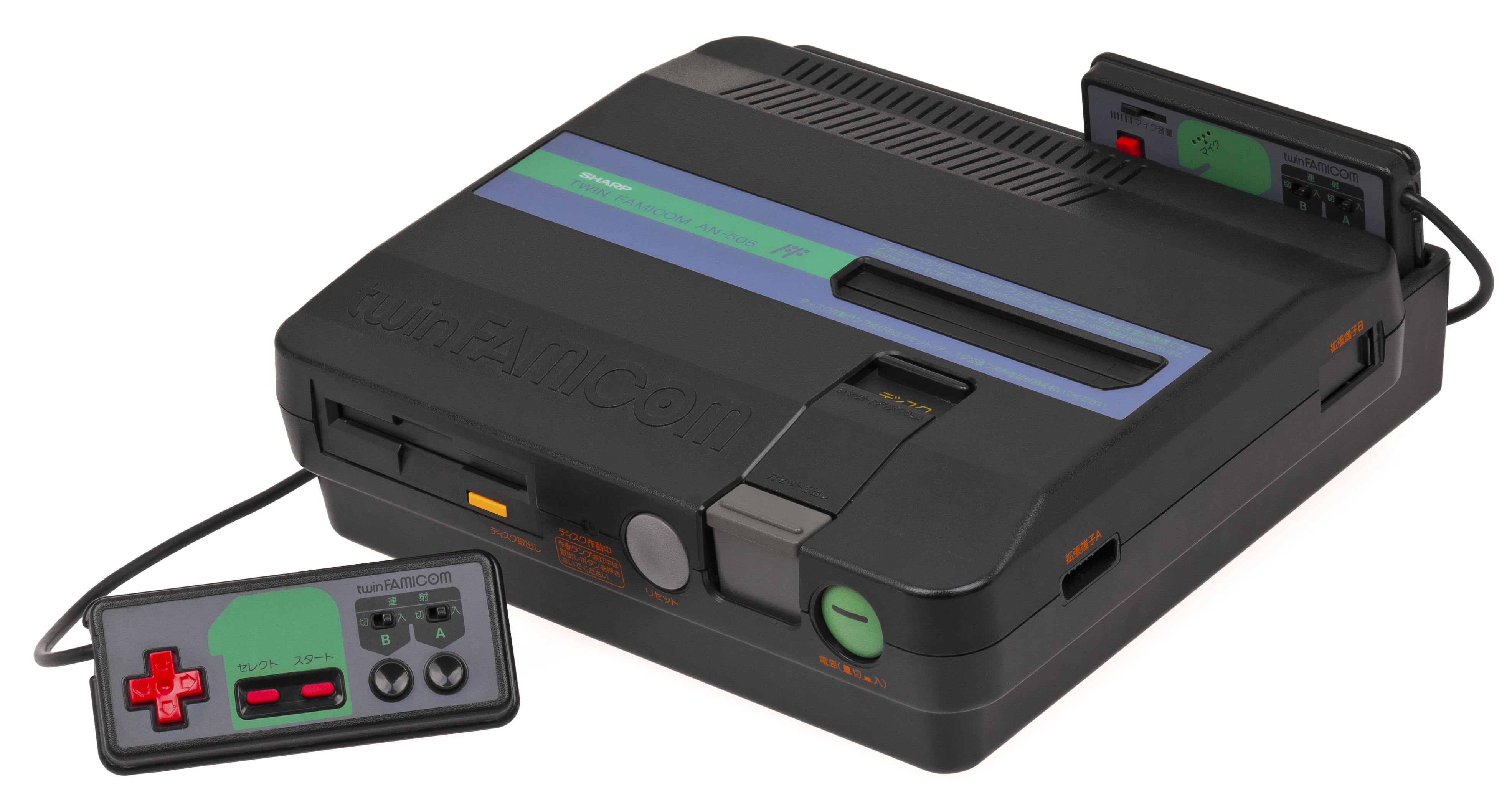
A licensed version of the Disk System called the Twin Famicom was released by Sharp. The Twin Famicom was a Famicom with a Disk System and extra RAM included in one chassis. The BIOS Screen had the word "Nintendo" replaced with "Famicom" due to the fact the system was not made by Nintendo.
Disk Writer
Until 2003, there were kiosks called "Disk Writers" where players could write games on disks. Some games, like Kaettekita Mario Bros., were exclusive to Disk Writers.
While not being used, the disk writer screen would show a demonstration video featuring Mario and Luigi showing how to write a game using pixelated versions of Famicom Disk System and Disk Writer. For unknown reasons, the game Time Twist: Rekishi no Katasumi de... was removed from the kiosks in 2002, a year before the Disk Writers were retired.
The Disk Writers were retired in September 2003 after the Famicom was discontinued.
Issues
The main reason for the FDS's Japan-only release is believed to be due to a lack of success caused by various issues:[1]
- The games were easier to pirate, due to weak copy protection (i.e. recognizing legitimate disks by the physical shape of the disk).
- The games were easier to damage, as floppy disks are susceptible to data corruption upon exposure to a magnetic field. The Disk Cards were even more susceptible to physical damage because they lacked a disk shutter, which normally covers the reading window of other floppy disks. This allowed dust and dirt to affect the disk much more easily. In some cases, mold could form on the disk. Only a few Disk Cards, colored blue, included a disk shutter.
- Most games required the player to eject the disk at various points, flip it over, and re-insert it (often after the title screen and on the game's final stretch), similarly to how various games on multiple CDs required the player to eject and swap CDs at certain points.
- The games had lengthy loading times at various points (often when swapping sides, loading large amounts of data, or saving).
- The jewel cases that contained the games were smaller than cartridge boxes, and were therefore easier to overlook in stores or lose in homes. The cases were also required to fully protect the disk, whereas cartridges could be stored, standalone, on shelves.
- Initially, the disks had a higher capacity than cartridges. However, by the time a US release was starting to be considered, cartridge technology had evolved to the point where they could hold more data than the disks, and could accommodate batteries for saving game progress as well as additional chips to improve the system capabilities, effectively rendering the disks obsolete.


.jpg)

Bootlegs
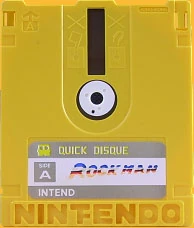

A bootleg version of Rockman for the Disk System. The label states "Intend", while the embossing on the disk reads "NinFendo".
All disk cards for the system featured the word "NINTENDO" molded at the very bottom. The "I" and the second "N" on the disks activated a switch that authenticated them and allowed the games to run. However, this was easily worked around, as the molding could very easily be copied. Since only two letters had to be correct, many other names which did not infringe on Nintendo's name trademark could be used. Examples used include NinFendo, Ninten, Ninjendo, Intend, Ninendo, Niniendo, and Niniendd. Eventually the producers of these bootleg disks managed to mold only the necessary letters with no need for a fake "Nintendo" logo.
Legacy
A very slowed down rendition of the BIOS screen theme is played in the Nintendo GameCube system menu.
Diskun, the mascot for the Famicom Disk System, became quite popular in Japan. Merchandise featuring the character was produced in the country and a trophy of it was present in the Nintendo GameCube video game Super Smash Bros. Melee.
Diskun also made a brief appearance in the Famicom video games Smash Ping Pong, Famicom Golf: Japan Course, Famicom Golf: U.S. Course, and Nakayama Miho no Tokimeki High School (released only in Japan) and later in WarioWare: Smooth Moves, on a poster in a game shop, and WarioWare Touched!, as a tattoo on a guitarist from a microgame. The theme that plays when the Disk System is turned on is used, in a highly slowed-down form, as the menu theme for the Nintendo GameCube. The theme also appears as a sample song for the Rock Organ in Daigasso! Band Brothers DX.
Additionally, it is believed that the rampant piracy problems that the Famicom Disk System suffered from were the motive behind Nintendo's more aggressive piracy prevention measures in later years, particularly after the advent of the internet.
External links
- Family Computer Disk System at Wikipedia, the free encyclopedia